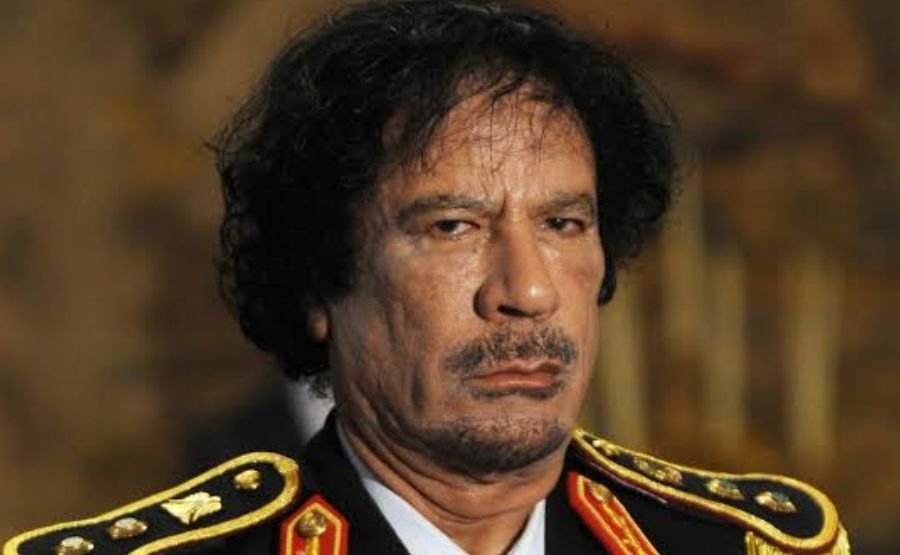
Muammar Gaddafi: The Colonel Who Turned a Country Into His Personal Experiment
Quick Bio
| Detail | Info |
| Full Name | Muammar Muhammad Abu Minyar al-Gaddafi |
| Born | Around June 7, 1942 — near Sirte, Libya (exact date uncertain) |
| Died | October 20, 2011 — Sirte, Libya (aged approximately 69) |
| Nationality | Libyan |
| What He Did | Military officer, de facto ruler of Libya for 42 years |
| Biggest Accomplishments | Led the 1969 coup that ousted King Idris; nationalized Libya’s oil industry; authored The Green Book; held power longer than any non-royal leader of his era |
| Other Key Facts | Linked to the 1988 Lockerbie bombing that killed 270 people; survived a 1986 US airstrike on his Tripoli compound; estimated fortune at death ranged from $70 billion to $200 billion — much of it never recovered |
Why the World Still Can’t Stop Talking About Him
Here’s the thing about Gaddafi — he’s impossible to reduce to a single sentence. You can call him a terrorist sponsor and you’re right. You can say he built hospitals and schools where there were none and you’re also right. You can point to the torture chambers, the secret police, the decades of political repression, and you’re absolutely right about all of that. But then you’d be missing the part where he genuinely upended the Western oil industry’s grip on a developing nation and channeled billions into infrastructure his people had never seen before.
He’s still talked about because he’s a warning and a puzzle at the same time. What happens when a genuinely ideological young revolutionary gets absolute power and keeps it for four decades with no one allowed to check him? Libya is the answer. It’s not a comfortable one.
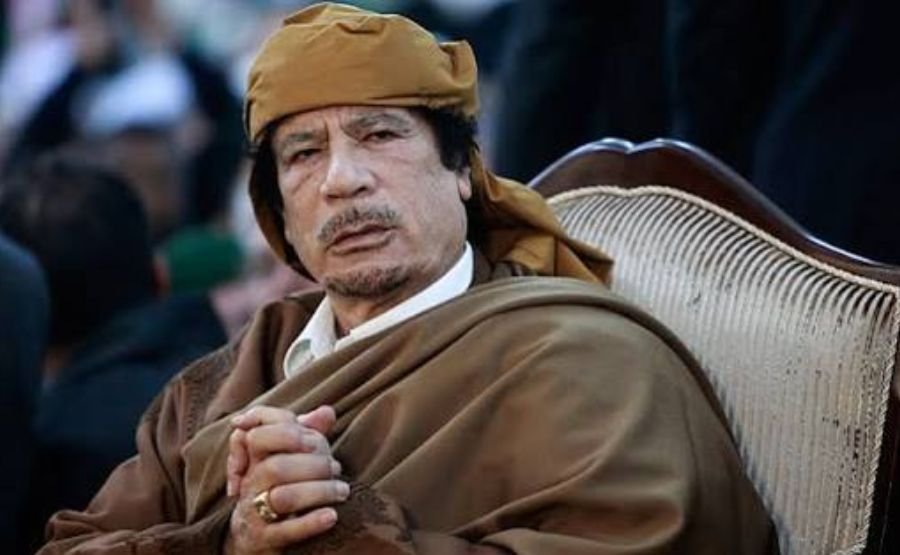
He also had a flair for the theatrical that made him almost impossible to look away from. The all-female bodyguard unit. The Bedouin tent he pitched on foreign soil during state visits. The floor-length robes and the sunglasses and the speeches that went on for hours. He understood that spectacle was power long before most politicians figured that out.
See also “Ross Perot: The Little Man With the Giant Mouth Who Changed American Politics“
A Tent in the Desert and a Boy Who Wanted More
Gaddafi was born in the Libyan desert near Sirte, in a literal tent. His family were Bedouin — the Qadhadhfa tribe — and they lived a nomadic or semi-nomadic life in one of the most sparsely populated stretches of North Africa. There was no electricity, no running water, no fixed address. Libya had only just become an independent country a few years before he was born, and the interior where his family roamed was about as far from political power as you could get.
He was the only son, and the youngest of his siblings. His father was effectively illiterate but understood, in the way many parents do, that education was the door out of poverty. He arranged for young Muammar to study under a Quranic teacher at home before the boy was old enough for a proper school. By around age nine or ten, Gaddafi was walking miles each week to attend elementary school, sometimes sleeping at the home of a local family during the week because the commute was too far to make daily. That early taste of wanting something badly enough to sacrifice for it seems to have never left him.
School, Nasser, and the Idea That Lit a Fire
When Gaddafi reached secondary school age, he ended up in the city of Sabha, in southwestern Libya. This was where his political education really began — not from a teacher, but from a radio. Specifically, from the broadcasts of Gamal Abdel Nasser, the Egyptian president who had seized power in 1952 and turned himself into the symbol of Arab nationalism across the entire region.
Nasser’s message was intoxicating if you were a young Arab man growing up in a country that had been colonized by Italy, then occupied by British and French forces, and was now nominally independent but in practice still heavily influenced by Western powers and a conservative monarchy friendly to their interests. The message was: we can run our own affairs. Our oil, our land, our future. Gaddafi absorbed every word.
He was also expelled from Sabha at some point for his political organizing — agitating his fellow students, spreading nationalist ideas, generally being a disruptive presence. Rather than dampening his ambitions, it seemed to sharpen them. He understood that the military was the only real ladder for someone of his background, and that’s exactly the ladder he started climbing.
He enrolled at the military academy in Benghazi in the early 1960s, and later did some military training in Britain. He studied briefly at the University of Libya — history was his subject — before the army became his full focus. Throughout this time, the underground network of young officers he was building quietly was always the real project.
The Coup at Twenty-Seven
On September 1, 1969, while King Idris was out of the country receiving medical treatment abroad, Gaddafi and a small group of military officers — his Revolutionary Command Council — seized control of the government. It was almost bloodless. The king’s forces either stood down, were caught completely off guard, or quietly switched sides. By morning, a 27-year-old captain had become the most powerful man in Libya.
He didn’t promote himself to general. He took the rank of colonel and stayed there for the rest of his life. It was a deliberate choice, partly ideological — Nasser had done the same in Egypt — and partly strategic. It kept him nominally a man of the people rather than a monarch by another name. The symbolism mattered.
What he did next moved fast. He expelled the American and British military bases that had been operating in Libya since World War II. He nationalized, or heavily renegotiated, the contracts that Western oil companies had signed with the old regime — contracts that had given those companies an embarrassingly large share of Libyan oil revenues for almost nothing. The oil money started flowing to Libya instead. Schools got built. Hospitals opened. Housing appeared. Literacy rates climbed. For ordinary Libyans who had lived under poverty and monarchy, the early years of Gaddafi’s rule felt genuinely transformative.
The Nation as Laboratory and the Green Book
In 1975 Gaddafi published the first volume of what he called The Green Book — a slim, strange document that laid out his political philosophy, which he called the Third Universal Theory. It rejected both capitalism and Soviet communism, proposing instead his own version of direct democracy through local “people’s committees” and a kind of socialist sharing of resources. It was part political manifesto, part utopian fantasy, and part barely coherent rambling, depending on which section you were reading.
In 1977 he formally restructured Libya as a Jamahiriya — a word he essentially invented, meaning something like “state of the masses.” He declared himself no longer the head of government but the “Brother Leader” and “Guide of the Revolution,” which was a clever way of making himself impossible to formally remove from power while technically holding no official title. The committees he created gave the appearance of popular participation. In reality, power ran through him and a tight circle of loyalists.
The Green Book became required reading in Libyan schools. Children memorized it. It was displayed in shop windows. It was the kind of ideological saturation that only works when the man behind it controls every institution that could push back.
Family Life Behind the Revolutionary Curtain
Gaddafi married twice. His first marriage, to Fatiha al-Nuri, ended in divorce. His second wife was Safiya Farkash, a nurse he married in 1969 and stayed with until his death. Together they had several children — his sons would become important figures in the regime’s later years, and most of them met violent ends during or after the 2011 uprising.
He also had an adopted daughter, Hana, who was said to have been killed in the 1986 US airstrike on his compound. Gaddafi pointed to her death for years as evidence of American brutality. It later emerged — when his compound was looted in 2011 — that Hana was alive and had been living privately in Tripoli. The story had been a propaganda construction.
He kept his private life as carefully controlled as everything else. Journalists who covered him for years noted that genuine access was essentially impossible. You witnessed what he decided to show you.
Terror, Sanctions, and the Years of Isolation
The 1980s were when Gaddafi’s international status curdled from “troublemaker” to “pariah.” Libya was linked to a string of terrorist attacks — most notoriously, the bombing of a West Berlin nightclub in April 1986 that killed two American soldiers and a Turkish civilian. President Reagan responded weeks later by ordering airstrikes on Tripoli and Benghazi. One bomb landed near Gaddafi’s residential compound. He survived, but the attack killed his adopted daughter — or so he claimed. The strike was meant to kill him. It didn’t.
Then came Lockerbie. On December 21, 1988, Pan Am Flight 103 exploded over a small Scottish town, killing 259 people on the plane and eleven more on the ground. The investigation pointed to Libyan intelligence. Gaddafi refused to hand over suspects for nearly a decade. The United Nations imposed sanctions. Libya became economically strangled — oil exports continued but investment dried up, spare parts for infrastructure became scarce, and the country slowly frayed.
He also sent troops into Chad, funded the IRA in Northern Ireland, supported the PLO, meddled in the affairs of countless African nations, and tried to undermine neighboring governments. He positioned himself as a pan-African leader in his later years, spending freely on influence across the continent.
The Rehabilitation That Never Really Took
In 1999, Gaddafi finally handed over two Libyan suspects in the Lockerbie case. In the end, one was found guilty while the other was found not guilty. Libya consented to compensate the families of the victims with $2.7 billion. Then, dramatically, in 2003, Gaddafi announced Libya would abandon its weapons of mass destruction programs and open them up for international inspection. It was a stunning reversal.
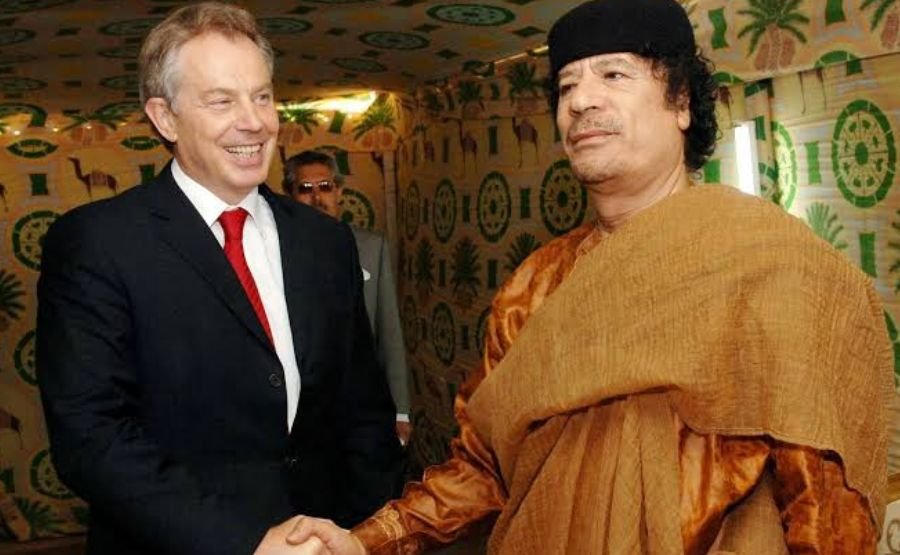
Western governments embraced it. To shake his hand, Tony Blair took a plane to Tripoli `. American companies began doing business in Libya again. The sanctions were lifted. Gaddafi was being rehabilitated into something almost respectable.
But inside Libya, almost nothing had changed. Political prisoners were still in jails. Dissent was still ruthlessly suppressed. The brief window of international goodwill didn’t translate into any loosening of the regime’s grip on its own people. Gaddafi had learned to manage the optics without changing the substance.
The Money: Staggering, Hidden, and Mostly Gone
Gaddafi’s wealth was essentially Libya’s wealth, because he treated them as the same thing. For four decades, oil revenues flowed through the state and a substantial portion was directed wherever he wanted it to go — funding foreign adventures, building a security apparatus, enriching his family and inner circle, and maintaining the patronage networks that kept him in power.
Estimates of his personal fortune vary wildly, and that’s the point — nobody actually knows. Conservative figures put it around $70 billion. Some analysts, accounting for hidden assets in Swiss bank accounts, Maltese institutions, Gulf state funds, and real estate across Europe, suggest the total could have reached $200 billion. After his fall, investigators from multiple countries began tracing assets and found pieces of the puzzle everywhere — investments, property, accounts under aliases and shell companies. Much of it has never been found or formally recovered.
His family lived in extraordinary luxury while averages Libyans had incomes that remained low relative to the country’s oil wealth. He built grand infrastructure — including the Great Man-Made River, one of the largest irrigation projects in history — but the benefit was always filtered through his control. The money was a tool of power, not a resource he was stewarding for his people.
The Arab Spring and the End
In February 2011, the wave that had already swept through Tunisia and Egypt arrived in Libya. It started with protests. Gaddafi’s response was immediate and brutal — he deployed troops, called protesters “rats” and “cockroaches” in televised speeches, and threatened to hunt opponents house by house through the streets of Benghazi. The language was so extreme that it pushed the international community into action faster than it might have otherwise moved.
The UN Security Council authorized a no-fly zone. NATO began airstrikes. The rebels — ragged and fractured at first — were given enough air cover to hold ground and eventually advance. Gaddafi’s forces began losing territory through the spring and summer. By August, rebels had entered Tripoli. His family fled to Algeria.
Gaddafi himself went into hiding in his hometown of Sirte. For weeks nobody knew exactly where he was. On October 20, 2011, rebel fighters found a convoy trying to leave Sirte. Gaddafi was pulled from a drainage pipe where he had taken cover. The video of what happened next — captured on mobile phones by the fighters who found him — is brutal and difficult to watch. He was beaten, abused, and shot. He died in the dirt near the city where he was born, forty-two years after he had seized power from a sickly king while still in his twenties.
Libya Today: Still Paying the Price
Gaddafi is gone but Libya hasn’t stabilized. Without institutions — because he had deliberately destroyed any institution that might challenge his authority — there was nothing to hold the country together once the center collapsed. Armed militias multiplied. Two rival governments emerged. ISIS moved in and controlled territory for a period. Foreign powers picked sides and pumped in weapons.
As of now, Libya remains deeply fragmented. Humanitarian conditions are poor in many areas. The oil wealth that once made Libya the wealthiest country in Africa by per capita income has become a prize that factions fight over rather than develop. The man who spent four decades insisting he was building a utopia left behind something very close to the opposite.
Final Words
Gaddafi is one of those historical figures who forces you to sit with moral complexity whether you want to or not. He was a genuine idealist who became a genuine monster — and the tragedy is that those two facts aren’t contradictory. He started with real grievances about colonialism and foreign exploitation that were entirely legitimate. He channeled that energy into a system that ultimately served himself and destroyed any mechanism that could have corrected the course.
What makes him different from other dictators isn’t the violence — that was sadly ordinary. It’s the ideological sincerity. He really seemed to believe his own theories. He really thought he had invented something new. And that belief made him more dangerous, not less, because it gave the repression a philosophical justification that was harder to puncture from the outside.
He’s a lesson about what happens when charisma, ideology, and unchecked power fuse into a single person with no institutional resistance around them. The result isn’t a revolution. It’s just a different kind of dynasty — one that ends in a drainage pipe.
FAQs
1. How did Gaddafi come to power?
He led a military coup on September 1, 1969, while King Idris was abroad. A small group of young officers took over key installations overnight. It was nearly bloodless, and by morning Gaddafi was in charge.
2. Why was he called “Colonel” if he ran the whole country?
He chose not to promote himself to general after taking power — a deliberate echo of his idol Nasser, who did the same in Egypt. It was a way of appearing as a revolutionary rather than a traditional military ruler. He kept the rank of colonel for the rest of his life.
3. What was the Green Book?
It was Gaddafi’s political manifesto, published in the mid-1970s, outlining his “Third Universal Theory” — a rejection of both capitalism and communism in favor of what he called direct democracy through people’s committees. It was required reading in Libyan schools. In practice, it provided ideological cover for his one-man rule.
4. Was Libya actually better off under him?
In the early years, yes — measurably. Oil revenues funded schools, hospitals, housing, and infrastructure for a population that had almost none of it under the old monarchy. Literacy rose. Basic services expanded. But over time, corruption, mismanagement, and the total absence of accountable governance undid most of those gains for ordinary people while the regime’s inner circle grew fabulously wealthy.
5. Did he really order the Lockerbie bombing?
Libya officially accepted responsibility in 2003 and paid $2.7 billion to victims’ families. A Libyan intelligence officer was convicted. Whether Gaddafi personally ordered it has never been proven in a court, but the weight of evidence points to state-sponsored involvement.
6. What happened in the 1986 US airstrike?
After Libyan agents bombed a Berlin nightclub frequented by American military personnel, killing two US soldiers, President Reagan ordered airstrikes on Tripoli and Benghazi. Bombs landed near Gaddafi’s compound. He survived. He subsequently claimed his adopted infant daughter Hana died in the attack — though she turned out to be alive and living privately in Libya.
7. How did he die?
During the 2011 uprising, rebel forces captured Sirte — his hometown and last stronghold. He was found hiding in a drainage culvert, pulled out, beaten, and killed by the fighters who found him. The footage was widely circulated globally.
8. How much money did he have?
No one knows with certainty. Estimates range from $70 billion to as high as $200 billion, accumulated over four decades of treating Libya’s oil revenues as personal funds. A significant amount of money has never been located and was concealed in foreign accounts, real estate, and investments.
9. Did he really pitch a tent during state visits?
Yes. He frequently had a large Bedouin-style tent erected wherever he traveled — in foreign capitals, at the United Nations in New York, in various European cities. It was theatrical and deliberate, presenting himself as a man of the desert even while staying in palaces.
10. Who ruled Libya after him?
Nobody, in any stable sense. The country fractured into competing armed factions and rival governments. Various militias, internationally backed authorities, and at one point ISIS all controlled different territories. Libya has not achieved stable governance since 2011.
11. Did he have family?
Yes — two marriages, multiple children. His sons Saif al-Islam and Mutassim were prominent in the regime and both were captured or killed during the 2011 conflict. Several family members fled to Algeria. Saif al-Islam survived, was held for years, and has appeared publicly in Libya more recently amid continuing instability.
12. Why does he still matter?
Because Libya is still broken by what he built and what he left behind. And because his arc — from idealistic young revolutionary to paranoid authoritarian to violent end — is a near-perfect case study in what unchecked power does to a human being and a nation over time. That’s worth understanding.
Explore new ideas and rising trends with Trend Rise.