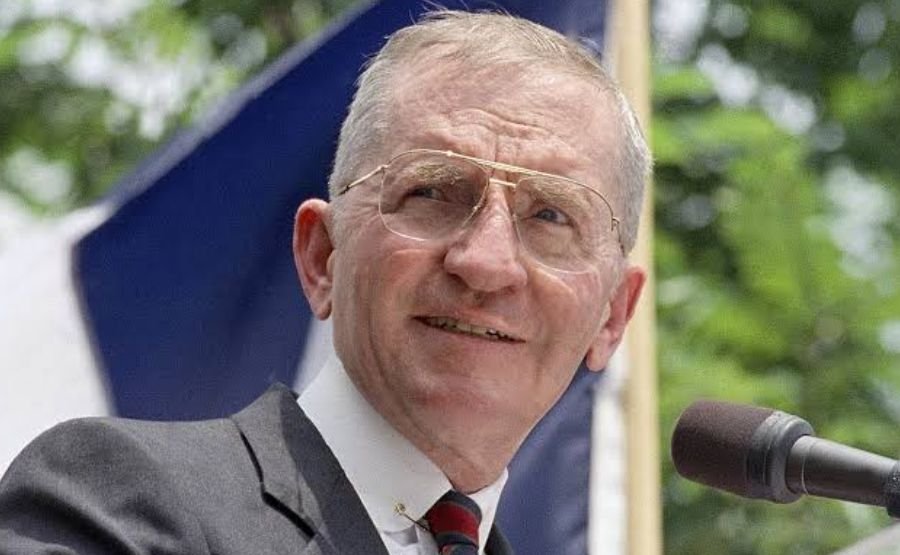
Ross Perot: The Little Man With the Giant Mouth Who Changed American Politics
Quick Bio
| Detail | Info |
| Full Name | Henry Ross Perot |
| Born | June 27, 1930 — Texarkana, Texas |
| Died | Dallas, Texas, July 9, 2019 (old 89) |
| Nationality | American |
| What He Did | Entrepreneur, billionaire, two-time independent presidential candidate |
| Biggest Accomplishments | Founded Electronic Data Systems (EDS); sold it to General Motors for roughly $2.5 billion; captured nearly 19% of the popular vote in the 1992 presidential race — one of the strongest third-party showings in a century |
| Other Key Facts | Personally financed a commando mission to rescue two of his employees from an Iranian prison in 1979; had an estimated net worth of $4 billion at death; was survived by five children and 19 grandchildren |
Why People Still Talk About Him
Ross Perot is one of those people who seems impossible in hindsight. A short, big-eared Texan with a nasal twang and a fondness for pie charts just walked into the middle of a presidential election and nearly broke the two-party system. He didn’t come close to winning, but he made 19 percent of Americans vote for a guy with zero political experience and zero party behind him — purely on the strength of personality and a message that rang true.
That’s the thing that keeps his story alive. He wasn’t a fringe candidate. He led the polls at certain points in 1992. He scared both major parties half to death. And he did it all while spending his own money, buying half-hour TV spots instead of thirty-second ads, and talking to voters like they were adults who could handle a spreadsheet.
Then there’s the rescue story. The Iran thing. That part reads like a thriller novel — because it literally became one. A billionaire businessman organizing a private mercenary operation to break his own employees out of a Middle Eastern prison is not a sentence you expect to type about a real person. But that’s the Perot story. Larger than life, and then a little larger still.
See also “John Candy: The Big Heart Behind the Laugh“
Growing Up in Texarkana, Right on the Line
Texarkana sits exactly on the border between Texas and Arkansas. It’s the kind of town that’s a little proud of its geographic quirk and not much else going on. Ross Perot was born there in June 1930, right at the start of the Great Depression, into a family that didn’t have a lot but made the most of what they had.
His father, Gabriel Ross Perot, was a cotton broker — a man who lived by buying and selling, reading the market, knowing what things were worth. His mother, Lula May, was by all accounts warm, strict in the right ways, and deeply invested in her kids’ character. Gabriel Ross Jr., Ross’s elder brother, passed away as a toddler prior to Ross’s birth. He was given his late brother’s middle name — Ross — and legally adopted it as his own when he was around twelve. So he was born Henry Ray Perot and became Henry Ross Perot, which tells you something about family loyalty being baked in from early on.
He started making money almost comically young. By age seven he was doing odd jobs. In his early teens he was delivering newspapers on horseback — he had a route that other kids couldn’t cover on foot, so he charged more. He also bought and traded horses and other animals, figuring out margins before he knew the word for it. His dad modeled that mindset constantly, and it stuck.
The Naval Academy and the Making of a Leader
When Perot finished high school in Texarkana, he didn’t have a clear path to college. So he wrote letters — actual physical letters — to his congressional representatives, asking for an appointment to the United States Naval Academy at Annapolis. He was persistent about it. It took a couple of tries but eventually he got in, enrolling in the late 1940s.
Annapolis shaped him significantly. He was elected class president in both his junior and senior years, which says everything about his ability to read a room and inspire people who are watching you closely. He graduated in 1953 and was commissioned as a naval officer.
He served four years — on a destroyer and later on an aircraft carrier. It was during his time on the carrier that something useful happened almost by accident. He was escorting a group of visitors around the ship when he met an executive from IBM. That conversation planted a seed. When Perot left the Navy in 1957, he headed to Dallas and walked in the door of IBM looking for work.
IBM, Quotas, and the Spark That Built a Company
Perot turned out to be extraordinarily good at selling. IBM in the late 1950s was a rocket ship, and he was one of its engines. He was so effective that he hit his entire annual sales quota for the year by the middle of January — yes, January — leaving him with nearly twelve months of nothing to sell. IBM’s quota system had no idea what to do with him.
That frustration was the trigger. If you’re the best salesman in the building and the system punishes you for being too good too fast, eventually you stop asking for permission and start building your own system. That’s exactly what Perot did.
He used $1,000 of his own money to start Electronic Data Systems, or EDS, in 1962. He also apparently received some funding from his wife Margot, who was teaching at the time. The idea was simple but perfectly timed: companies were adopting computers rapidly, but most of them had no idea how to actually run the software side. EDS would do that for them. Data processing as a managed service. It sounds obvious now. In 1962 it was visionary.
The company grew slowly at first. The breakthrough came when Medicare and Medicaid launched in the mid-1960s. The government needed someone to manage the flood of insurance claims for these massive new programs. EDS got the contracts, starting in Texas and then spreading nationally. It was unglamorous work — processing paperwork — but the scale was enormous and the margins were real.
In 1968, when EDS went public, Perot became a multimillionaire overnight. The stock made him worth something like $350 million on day one of trading. He was 38.
The Iran Rescue: The Chapter Nobody Believes Is Real
In 1979, the Iranian Revolution was underway. EDS had two senior executives working in Tehran — Paul Chiapparone and Bill Gaylord — and when the regime collapsed, they got swept up in the chaos and thrown in Evin Prison. The Iranian government wanted $13 million to release them. Perot said no to the ransom. However, he added that he would not abandon his countrymen in a foreign jail.
Thus, he assembled a group of EDS volunteers and hired Arthur “Bull” Simons, a veteran Special Forces colonel who had actually directed combat operations. for a rescue mission. The plan involved agitating prisoners until a riot broke out, using the chaos to extract the two men, and then moving them through Turkey to safety. It worked. Both men got out. The whole thing was later written up by Ken Follett in On Wings of Eagles, which became a bestseller and a TV miniseries.
Take a moment to consider that. A private citizen organized a commando extraction from a maximum-security prison during a revolution. Because two of his employees needed help and he’d promised they’d be taken care of. That wasn’t a marketing stunt. That was just who he was.
The GM Years, the Falling Out, and the Next Chapter
In 1984, Perot sold EDS to General Motors for around $2.5 billion. He walked away personally with something close to $800 million in cash and became GM’s largest individual shareholder. He also joined the board of directors, which turned out to be a disaster — not financially, but personally.
Perot and GM’s CEO Roger Smith were about as compatible as oil and water. Perot was blunt, impatient with bureaucracy, and deeply unhappy watching GM’s culture slowly strangle the company’s competitiveness. He said so publicly, loudly, and repeatedly. GM eventually paid him nearly $700 million just to go away — to buy back his stock and remove him from the board. It’s one of the stranger corporate transactions in American history. They essentially paid him a fortune to stop criticizing them.
He wasn’t done building, though. In 1988 he launched Perot Systems, another technology services company. Same model, new era. It grew steadily and was eventually acquired by Dell in 2009 for about $3.9 billion.
Margot and the Family He Built
Perot married Margot Birmingham in 1956, right after leaving the Navy. She taught school while he was climbing through IBM. She was by all accounts steadying — grounded where he was volcanic, patient where he was relentless. They were married for 63 years, until his death. Five children: Ross Jr., Nancy, Suzanne, Carolyn, and Katherine. Nineteen grandchildren by the end.
Ross Jr. followed his father into business and took over leadership of Perot’s real estate and investment operations. The family has stayed close-knit and relatively private despite the spotlight that came with the presidential runs.
Perot was, by reputation, fiercely loyal to the people around him and expected the same back. The idea that he would go to great lengths for you if you were in his social circle was a topic of frequent discussion among former employees. The Iran mission is the most extreme example, but there were quieter ones too. People he helped financially. Veterans he supported. Communities he poured money into without looking for credit.
The 1992 Run and the Night American Politics Got Weird
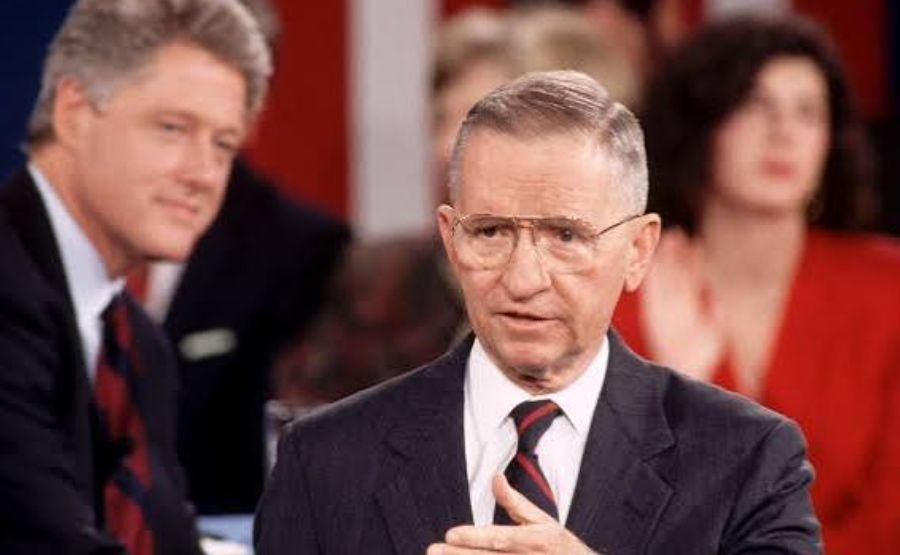
The presidential campaign of 1992 is where most people remember Perot, and it’s worth slowing down on it because it was genuinely strange. He didn’t run through a party. He ran as himself. He began his campaign by appearing on CNN’s Larry King Live, essentially challenging the American people to force him to do so if a sufficient number of them desired it. run, he’d run. They did. He did.
He used his own funds to spend $63 million. He bought half-hour blocks of television time and filled them with charts showing the national debt and trade deficits, talking directly to voters like a professor who’d had enough of being ignored. And people watched. Millions of them. Because he was saying things out loud that the other candidates were tiptoeing around — that the country’s fiscal situation was a slow-motion disaster, that both parties were too comfortable to fix it, that someone who’d actually built something might be better equipped to run something.
He was leading the three-way polls in June of 1992. Leading. Then he pulled out suddenly in July, citing threats to his family and what he claimed was Republican dirty tricks. Then he came back in October — too late to rebuild the momentum, but still enough to pull 19 percent on election day. George H.W. Bush lost to Bill Clinton, and both men spent years wondering how much Perot had cost them.
Dana Carvey parodied him mercilessly on Saturday Night Live. Perot didn’t seem to mind.
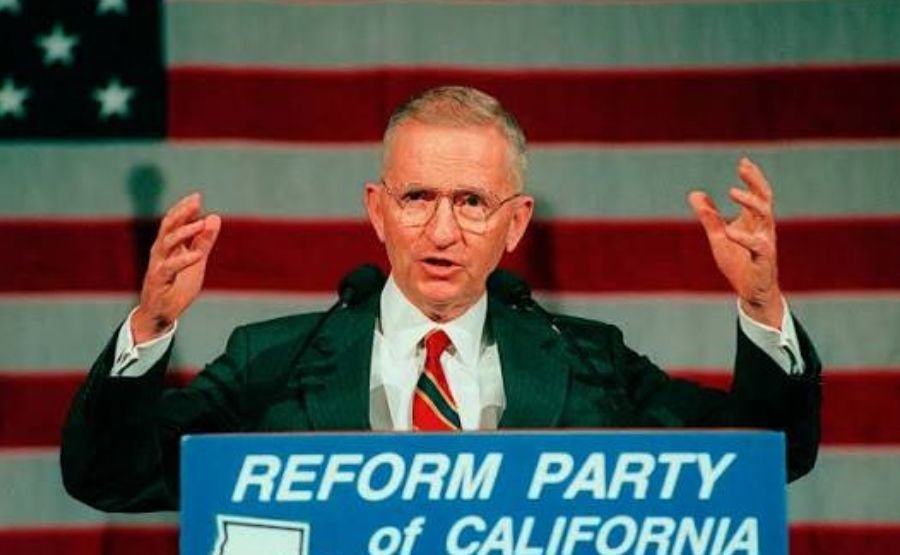
In 1996 he ran again, this time under the Reform Party banner he’d helped create. It was a much quieter campaign — he was shut out of the presidential debates because organizers said his poll numbers didn’t justify inclusion, which felt like the system protecting itself. He received almost 8% of the vote. The moment had passed.
The Money, Simply Explained
At the time of his death in 2019, Forbes put Ross Perot’s net worth at about $4.1 billion. That’s a real number earned entirely from scratch — from a kid delivering newspapers on horseback in Depression-era Texas to one of the wealthiest people in America.
The big accumulation points were EDS going public in 1968, the GM sale in 1984, and Perot Systems’ eventual acquisition. He possessed a sizable real estate holdings as well. His Dallas home sat on 16 acres and was worth around $21 million. He sold property in Bel-Air to filmmaker George Lucas in 2017.
He wasn’t reckless with it. He gave large amounts to veterans’ causes, educational institutions, and various community organizations over the decades. He funded things quietly more often than publicly.
His Final Years and the End
Perot stepped back from business around 2000 and handed the day-to-day operation to his son Ross Jr. He was in his seventies and had earned the slower pace. He remained active, opinionated, and connected to events right up until the end.
He was diagnosed with leukemia — the blood cancer kind — sometime in the years before his death. He fought it for about five months at the end. On the morning of July 9, 2019, he died at home in Dallas, surrounded by his family. He was 89.
A statement from his family called him “an extraordinary man.” That’s the kind of understated line you write when the actual sentence would take a paragraph.
Final Words
What makes Ross Perot genuinely unusual is that he operated outside every system that was supposed to contain him. IBM’s quota system couldn’t hold him. GM’s board culture couldn’t manage him. The two-party political structure couldn’t absorb him. He discovered the door and constructed something new on the opposite side each time a structure attempted to define his ceiling.
He was also, underneath the combativeness, a man with a real code. You don’t spend your own money rescuing employees from a foreign prison unless loyalty actually means something to you. You don’t run for president on a platform of fiscal honesty unless some part of you genuinely believes the country is owed a straight answer.
He was imperfect — stubborn, sometimes paranoid, prone to conspiracy thinking in his later political life. But the foundation underneath all of it was solid. A kid from Texarkana who started with nothing and ended up reshaping American politics just by showing up and refusing to play by the rules everybody else accepted. That’s a story worth knowing.
FAQs
1. Who exactly was Ross Perot?
He was a Texas-born entrepreneur who built one of the most successful technology services companies of the 20th century, then ran for president twice as an independent and nearly upended American politics in the process.
2. How did he make his money?
Primarily through Electronic Data Systems, which he founded in 1962 and sold to General Motors in 1984 for around $2.5 billion. He later founded Perot Systems, which Dell acquired in 2009 for about $3.9 billion.
3. How well did he actually do in the 1992 election?
He got nearly 19 percent of the popular vote — no electoral votes, because he didn’t carry any state outright. But that popular vote percentage is remarkable for a candidate with no party behind them.
4. Did Ross Perot cost George H.W. Bush the 1992 election?
It’s genuinely disputed. Some analyses suggest Perot pulled roughly equally from both Bush and Clinton voters. Others argue Bush’s collapse was happening regardless. There’s no clean consensus.
5. What was the Iran rescue story?
In 1979, two EDS executives were imprisoned in Tehran during the Iranian Revolution. Perot refused to pay ransom and instead hired retired Special Forces soldiers to organize a rescue. The mission succeeded, and the whole story was later published as On Wings of Eagles by Ken Follett.
6. Why did he drop out of the 1992 race mid-campaign?
He cited concerns about threats to his family and alleged Republican dirty tricks. Many observers thought the real reason was the pressure of the campaign becoming more intense than he anticipated. He came back in October, too late to fully recover.
7. What was EDS?
Electronic Data Systems — a company that managed data processing and technology infrastructure for large organizations, including government agencies running Medicare and Medicaid. It was essentially IT outsourcing before the term existed.
8. Was he Republican or Democrat?
Neither, really. He came from a conservative Texas business background and had Republican leanings earlier in life, but he ran as an independent in 1992 and founded the Reform Party for his 1996 campaign. He resisted clean partisan labels.
9. How did he die?
Leukemia. He passed away on July 9, 2019, at his home in Dallas. He was 89 years old.
10. What happened to his businesses after he died?
His son Ross Perot Jr. had already been running the family’s real estate and investment operations for years before his father’s death. EDS had long since been sold to GM and then to Hewlett-Packard in 2008. In 2009, Dell purchased Perot Systems.
11. How much was he worth when he died?
Forbes estimated his net worth at approximately $4.1 billion at the time of his death in 2019. He left behind a large estate, an extensive real estate portfolio, and five children who were already well established in their own right.
12. Why does his legacy still matter?
Because he demonstrated that a credible independent campaign for the presidency is possible — and frightening to the established parties. His 1992 run still gets studied by political scientists. And his business story, from $1,000 startup to multi-billion-dollar enterprise built on a genuinely new idea, is one of the cleaner self-made success stories of the 20th century.
Explore new ideas and rising trends with Trend Rise.



One Comment