
Daniel Borden Wheeler: The Man Who Makes Things
Quick Bio
| Detail | Info |
| Full Name | Daniel Borden Wheeler |
| Born | 1961, New Haven, Connecticut, USA |
| Nationality | American |
| What He Does | Multidisciplinary sculptor, furniture maker, set designer, photographer, and producer of holy environments and ceremonial and burial items |
| Biggest Accomplishments | 2014 Faith and Form Award from the Interfaith Forum on Religion, Art and Architecture; 2001 City of Los Angeles Visual Arts (COLA) Individual Artist Fellowship; work in permanent collections including the Santa Barbara Museum of Art, the Laguna Art Museum, the Henry Art Gallery in Seattle, and the Los Angeles County Museum of Art; displayed both domestically and abroad. |
| Other Key Facts | Graduated Brown University (BFA in Sculpture, 1984); spent time living in Japan; married to actress Maggie Wheeler since October 20, 1990; father of two daughters, Juno and Gemma |
Why People Keep Googling This Man
Okay, here’s the thing about Daniel Borden Wheeler: most people stumble onto him the same way. They’re watching a Friends reunion clip, they see Maggie Wheeler — you know, Janice, the one with the laugh and the “Oh. My. God.” — and they wonder: who did she end up with in real life? And then they fall down a rabbit hole and discover someone genuinely fascinating. Not because of scandal or drama, but because this guy built an artistic life that very few people have managed to pull off with such quiet grace. He didn’t go the gallery-circuit route, didn’t chase celebrity, didn’t become a household name. Instead, over the course of four decades, he became someone that people seek out when they need something made that matters — a grave monument for someone lost too young, a church where ceremonies are place, and a sculpture made as a marriage proposal. You kind of can’t stop reading once you learn about it since it’s a very unique career to have developed.
The Early Years: New Haven Kid
Daniel was born in New Haven, Connecticut in 1961. He grew up in an environment where curiosity was clearly valued — those who knew his family have described his parents as brilliant and artistic, and his sisters made similarly strong impressions. None of that came accidentally.
As a kid, he was the type who couldn’t sit still unless his hands were busy. He built models, made dioramas, designed little sets for puppet shows — complete with actual lighting. In abstract creations, he took pictures of his Hot Wheels songs. He put together treehouses. At the time, nobody called it art, including Daniel himself. He simply did it because he was curious and there were many things in the world that warranted more investigation.
He didn’t grow up thinking, “I’m going to be a sculptor.” That’s kind of the whole point. He grew up being someone who figured things out by making them.
School and the Shape of a Mind
Daniel landed at Brown University in Providence, Rhode Island, and graduated in 1984 with a Bachelor of Fine Arts in Sculpture. Brown at that time had a notably open curriculum — students there had real latitude to follow their own intellectual threads, and for someone like Daniel, who was already That level of independence was perhaps ideal for a self-directed thinker.
What’s interesting about Daniel’s time at Brown is that he didn’t walk out with a tightly defined artistic identity. He walked out with a way of thinking about objects and space and the body’s relationship to physical things. That framework would take years to fully develop into the work he’s now known for, but the seeds were planted.
After graduation, he did something a little unexpected: he went to Japan. He spent time there before relocating to Los Angeles in the mid-1980s. Japan clearly left a mark. The aesthetic sensibility in his later work — the attention to material, the care around ritual, the idea that objects can carry spiritual or ceremonial weight — all of that resonates with traditions he would have encountered living in Japan. It’s the kind of cross-cultural influence that shows up not as direct imitation but as a deepened understanding of what objects can do.
The Career Finds Its Shape
Daniel settled in Los Angeles around 1984–1986 and slowly built what would become a singular practice. He wasn’t just a sculptor. He was a fabricator, a set designer, a furniture maker, a construction supervisor, a photographer, and a teacher. He operated his studio under the name Wheelermade, a name that says exactly what you need to know: this is a man who makes things.
Finding your true beliefs about art during your early years was a laborious and unglamorous process that required trial and error as well as a willingness to study new things. processes from scratch. Daniel has spoken about teaching himself most of what he does. His test for whether to dive into an unfamiliar material is almost disarmingly simple: Can I do it without hurting myself? And might I approach this material in a way a specialist never would? Sometimes that bet doesn’t pay off. But sometimes it opens up something remarkable.
What kept pulling him forward was a specific intellectual obsession. His work kept circling back to the relationship between the human body and three-dimensional objects. Not in an abstract theoretical way, but viscerally: you pick up a thing, you sit on a thing, you walk into a space. Your body measures itself against objects and they measure themselves against you. That exchange interested him enormously, and it still does.
The West Coast’s art criticism establishment was the first to recognize him. The Los Angeles Times featured his work in 1995. The San Francisco Chronicle and Sculpture Magazine wrote about him too. His piece Untitled (Wing) — an artwork that looked like an eroded airplane wing resting on a gallery floor, which he kept submerged in the ocean for six months so it would accumulate barnacles and algae — showed exactly where his imagination lived: at the intersection of the seen and the felt, the purposeful and the accidental.
The Turning Points
Two things really solidified Daniel’s reputation and pointed his career somewhere specific.
The first was the 2001 City of Los Angeles Visual Arts (COLA) Individual Artist Fellowship. This is a competitive grant for established LA artists, and receiving it was a signal from the art community that Wheeler’s work deserved serious attention. My Pompeii (2001–2002), his COLA show work, was completely different. It was a vibrant geometric landscape composed of plywood and linoleum that hovered just over the gallery floor on a steel frame. The whole structure had been built up around a plaster cast of a reclining human figure, whose shape disappeared beneath the accumulated layers — present but invisible, the way a person’s absence can still define a space. It got strong critical notice and ended up in the Hunsaker/Schlesinger gallery.
The second turning point was a quieter one. At some point Daniel began taking on funerary commissions — grave monuments, urns for ashes — and discovered that this particular kind of work did something to him that no other project could replicate. According to him, sarcasm and cerebral games have no place there. You’re working with someone in grief, often someone who has lost a person too young or too suddenly, and you have to bring everything you have. He finds that the act of designing a memorial object forces clients to talk through who the person was — their colors, their textures, what they thought about, what they loved — and in that process, something healing happens. The person gets reconstructed in memory. That was not what Daniel anticipated when he began working on the project. He discovered it.
The Interfaith Forum on Religion, Art, and Architecture’s 2014 Faith and Form Award confirmed what many already knew: his work in hallowed spaces and ceremonial artifacts had crossed into genuinely significant territory.

The Private Life
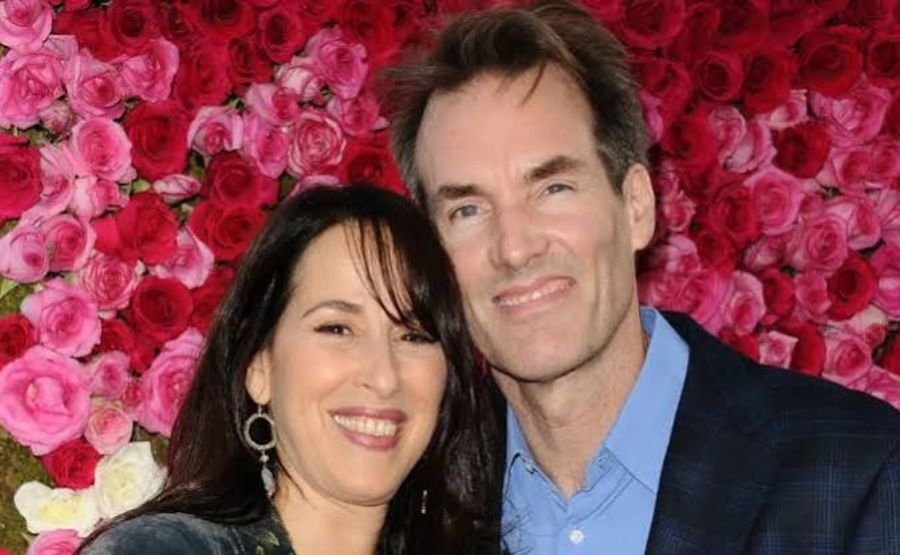
Daniel met Maggie Wheeler — she was still Maggie Jakobson at the time — sometime in the late 1980s. They married on October 20, 1990, in an intimate ceremony in Los Olivos, California, and have been together for over three decades since.
Naturally, Maggie’s portrayal of Janice on Friends has won her millions of fans. She’s also a serious musician and the co-founder of a community choir in Hollywood. What’s striking about how they describe their relationship is how much it comes down to artistic kinship. They’re doing completely different things — she makes music and acts, he makes physical objects — but they both understand what it means to be compelled to create. They speak the same language at the root, even when everything on the surface looks different.
Daniel has said that he’s made sculpture Valentines for Maggie since they met, and for both daughters all their lives. The house fills up with these objects. It’s such a specific detail, and it tells you so much about who he is.
Their daughters are Juno and Gemma. One had started a profession as a social worker while the other was starting an acting career by the early 2020s.
Hard Times and How He Stayed the Course
Daniel’s path wasn’t without difficulty, though he tends to discuss challenges with a kind of philosophical lightness rather than bitterness. The reality of being a working sculptor in Los Angeles — particularly one pursuing conceptual and ceremonial work rather than commercial or celebrity-adjacent projects — is that the market is small and the hustle is real.
He’s talked about trying to stop making things at various points. Wondering if he should do something “useful.” But it never stuck. The pull back to making was always stronger. And rather than seeing that as a weakness, he reframed it: he just kept redefining what “useful” meant. Making a memorial urn that helps a family reconstruct a lost person in their minds — that’s useful. Building a chapel where rituals can happen — that’s useful. Designing a kinetic stage set on which a dance company performs — useful.
What Daniel developed, through years of working outside conventional art-world structures, was a level of self-sufficiency that most artists don’t have. He could design it, build it, photograph it, install it, and supervise the construction. That breadth made him indispensable in a way that gallery representation alone never could.
Money and Where Things Stand
Daniel’s exact net worth isn’t something he’s made public, and he doesn’t seem particularly interested in changing that. His work isn’t priced the way commercially famous artists’ work is, and he’s clearly never operated with that kind of profile as the goal.
What’s clear is that he makes a living doing genuinely specialized work that commands real value. Custom funerary monuments, architectural chapels, large-scale installation environments, ceremonial silver objects, furniture, and sculptural commissions for clients who seek him out specifically — this is not cheap work, and he is not cheap to hire. Among those who are familiar with his work, he is said to be in great demand.
In 2022, AGEIST magazine profiled him at age 61 and described him as someone who wakes up excited to get to the studio every single day — a description of work-life integration that most people can only dream about.
Where He Stands Today
Now in his early-to-mid 60s, Daniel Borden Wheeler is at the height of his powers. His career continues to broaden rather than contract, encompassing funerary work, holy settings, conceptual sculpture, furniture, photography, and stage design. He recently made a stone cloud out of marble. He made a silver caviar dish in the shape of a sturgeon. He made a sculpture intended as a marriage proposal. The range is extraordinary.
His website is wheelermade.com and his Instagram, @wheelermadeitpublic, gives occasional glimpses into the studio work. He doesn’t court attention. He doesn’t need to. Those that require what he produces are aware of how to locate him.
Final Words
There’s something genuinely countercultural about the life Daniel Borden Wheeler has built. In an era obsessed with personal branding, followers, and visibility, he’s spent four decades quietly making extraordinary things for people who need them. He didn’t marry fame. He didn’t chase it. He followed curiosity — through a childhood of treehouses and puppet shows, through Brown, through Japan, through decades of self-teaching in wood and stone and metal and light — and he ended up somewhere most artists never reach: a place where the work itself is so distinctive, so human, so undeniably his, that the right clients find him rather than the other way around.
There isn’t a single item or honor that sets him apart. It’s the underlying philosophy. He believes craft is love — that sustained, careful attention to anything is a form of loving it. He extends that same quality of attention to grieving families, to sacred spaces, to the objects he makes for his wife every Valentine’s Day. He leads with love, pays attention, and then makes something.
That’s a life.
FAQs
1. Who exactly is Daniel Borden Wheeler?
He’s an American multidisciplinary artist born in New Haven, Connecticut in 1961. His practice includes sculpture, funerary objects, ceremonial spaces, furniture, set design, fabrication, and photography, all operating under his studio name Wheelermade.
2. Why do most people search for him?
Mostly because he’s married to Maggie Wheeler, the actress famous for playing Janice on Friends. But people who dig further tend to get genuinely interested in his art on its own merits.
3. Where did he grow up and go to school?
He grew up in New Haven, Connecticut, and graduated from Brown University in Providence, Rhode Island in 1984 with a BFA in Sculpture.
4. Did he have any formal training beyond Brown?
He’s largely self-taught in many of his techniques. After Brown he spent time in Japan and has described learning new materials and processes throughout his career by simply jumping in and experimenting.
5. What kind of art does he actually make?
Everything three-dimensional. Memorial urns, grave monuments, chapel interiors, kinetic stage sets, silver objects, marble sculptures, furniture, architectural installations. The connecting thread is his interest in how human bodies physically relate to objects and spaces.
6. What awards has he won?
The 2014 Faith and Form Award from the Interfaith Forum on Religion, Art and Architecture, and the 2001 City of Los Angeles Visual Arts (COLA) Individual Artist Fellowship, among others.
7. Is his work in any major collections?
Yes — the Los Angeles County Museum of Art, the Henry Art Gallery in Seattle, Laguna Art Museum, and the Santa Barbara Museum of Art, among others.
8. When and where did he marry Maggie Wheeler?
They married on October 20, 1990, at an intimate ceremony in Los Olivos, California.
9. Do they have children?
Yes, two daughters: Juno and Gemma.
10. How do they describe their relationship?
Both have said they share a deep investment in creating spaces where people can express themselves — he through physical art, she through music and performance. They’ve described understanding each other at the core level even though their work looks very different.
11. What is his net worth?
Not publicly disclosed. He manages commissions that vary greatly in size and value and operates a specialized, highly sought-after studio practice. He appears financially stable but has never sought the kind of fame that generates public wealth speculation.
12. Where can I see his work or contact him?
His Instagram account is @wheelermadeitpublic, and his website is wheelermade.com. He doesn’t have a massive social media footprint, but the studio work that does appear there is worth a look.
Explore new ideas and rising trends with Trend Rise.


One Comment